
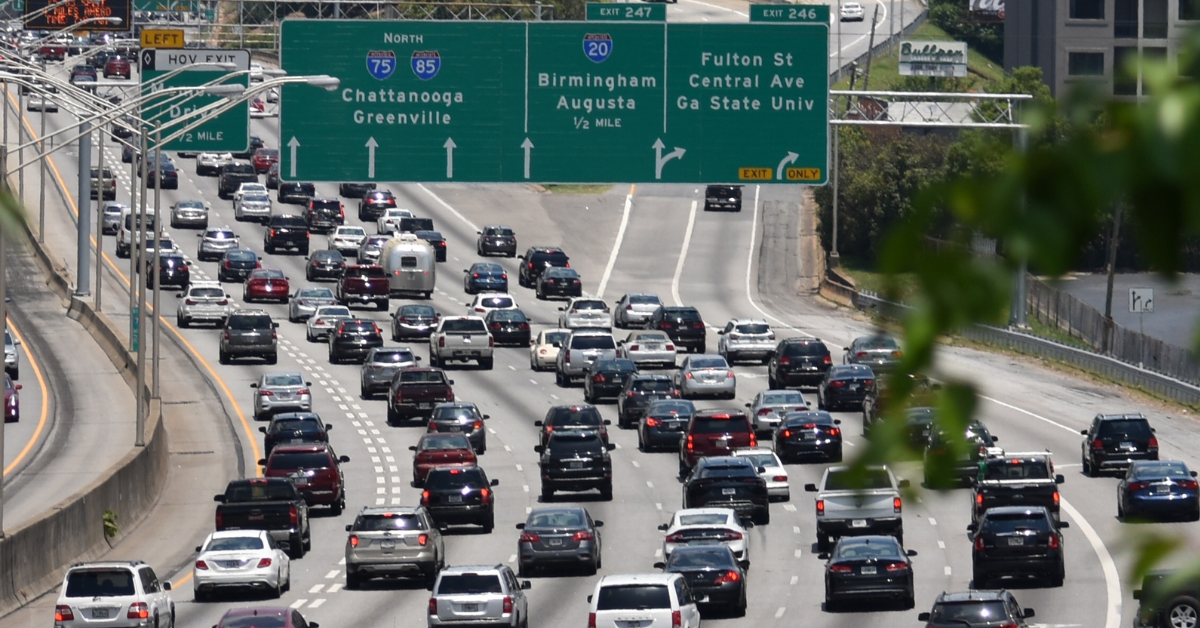
These Georgia truck accident statistics come from federal and state crash data, with the year and source for every number. The newest full year is 2024, when NHTSA counted 197 deaths in Georgia crashes involving large trucks. Last updated: October 29, 2026.
Key Georgia Truck Crash Numbers at a Glance
The newest official count is 197 deaths in Georgia crashes involving large trucks in 2024. Here are the headline numbers, each with its source and data year.
- 197 people died in Georgia traffic crashes involving large trucks in 2024 (NHTSA, Large Trucks: 2024 Data, DOT HS 813 816, preliminary FARS 2024 Annual Report File).
- 173 of those 197 were outside the truck: 142 were occupants of other vehicles and 31 were nonoccupants (NHTSA, same report).
- 189 large trucks were involved in fatal crashes in Georgia in 2024. That was 9.5% of all vehicles in fatal crashes in the state and 3.6% of the U.S. total for large trucks (NHTSA, same report).
- 270 people died in Georgia large-truck crashes in 2022 (final data), the highest year from 2020 through 2024 (NHTSA State Traffic Safety Information report, as published by GOHS).
- 5,340 people died nationwide in crashes involving large trucks in 2024, and an estimated 161,201 were injured (NHTSA, DOT HS 813 816).
- 377 fatal work zone crashes involving large trucks were recorded in Georgia over the past 10 years, the fourth highest among all states, according to GDOT’s Work Zone Safety fact sheet. The fact sheet does not state the exact years.
- 38% of Georgia crashes involving large trucks happened on interstates in 2021, compared with 12% of crashes involving other vehicle types (GOHS/CODES, Large Trucks: 2021 preliminary data).
Georgia Large-Truck Crash Deaths, 2020 to 2024
Georgia large-truck crash deaths rose from 2020 to a peak in 2022, fell sharply in 2023, and rose slightly in 2024. The table shows two NHTSA versions of the same measure, because early and final counts differ.
| Year | Deaths, NHTSA Traffic Safety Facts (first release, ARF) | Deaths, NHTSA STSI (Final File 2020-2022; ARF 2023) | Large trucks as % of vehicles in fatal crashes (Traffic Safety Facts) | All Georgia traffic deaths (STSI) |
|---|---|---|---|---|
| 2020 | 234 | 235 | 9.6% | 1,658 |
| 2021 | 244 | 246 | 9.3% | 1,809 |
| 2022 | 265 | 270 | 10.5% | 1,796 |
| 2023 | 188 | 188 | 8.2% | 1,615 |
| 2024 | 197 | Not yet in the STSI report we reviewed | 9.5% | Not yet in the STSI report we reviewed |
Sources: NHTSA Large Trucks reports for 2020 data (DOT HS 813 286), 2021 data (DOT HS 813 452), 2022 data (DOT HS 813 588), 2023 data (DOT HS 813 717) and 2024 data (DOT HS 813 816); NHTSA STSI report for Georgia.
Why the two columns differ: each annual NHTSA report uses the Annual Report File (ARF), which is preliminary. NHTSA says the ARF “is subject to change when it is finalized the following year.” The final counts for 2020 through 2022 ran 1 to 5 deaths higher than the first release. Both columns count people killed in a crash involving at least one large truck, which NHTSA defines as a truck with a gross vehicle weight rating over 10,000 pounds, excluding buses and motor homes.
Hurt in a crash? Talk with Jonathan Flack.
Free consultation. No fee and no case costs unless we recover money for you.
Texts go straight to attorney Jonathan Flack and his paralegal, Vashti. Calls are answered 24/7.
Where and When Truck Crashes Happen
Most fatal large-truck crashes happen on weekdays, and in Georgia a large share of truck crashes happen on interstates.
National Patterns (2024)
NHTSA’s 2024 report gives these national figures for fatal crashes involving large trucks:
- 25% occurred on interstates.
- 56% occurred in rural areas.
- 76% occurred on weekdays.
- Of the weekday crashes, 70% occurred in daytime, from 6 a.m. to 5:59 p.m.
Georgia and Metro Atlanta
Georgia’s most detailed published truck report covers 2021 (preliminary data). It found that 38% of crashes involving large trucks statewide were on interstates, versus 12% for other vehicle types. It also found that 53% of all traffic crashes involving large trucks happened in the ten-county Atlanta region: Cherokee, Clayton, Cobb, DeKalb, Douglas, Fayette, Fulton, Gwinnett, Henry and Rockdale (GOHS/CODES, 2021).
I-285, I-75, I-85 and I-20
We did not find an official published count of truck crashes for I-285, I-75, I-85 or I-20 in metro Atlanta. What the law does say: most through trucks must use I-285 rather than the interstates inside the Perimeter (O.C.G.A. § 40-6-51). Our page on I-285 and I-85 truck accidents in Atlanta explains that rule. Work zones add risk on these corridors, and GDOT’s fact sheet reports the 377 fatal work zone crashes involving large trucks noted above.
County-Level Data
None of the official sources we reviewed publish truck-specific crash counts for Fulton, DeKalb, Cobb, Gwinnett or Clayton County. The 2021 GOHS report gives only the Atlanta region share. We do not estimate county figures.
Common Factors in Large-Truck Crashes
The most detailed federal study of why truck crashes happen is FMCSA’s Large Truck Crash Causation Study (LTCCS). It examined 967 crashes from 2001 through 2003, each involving at least one large truck and at least one death or injury. The truck was assigned the “critical reason” for the crash in 55% of cases.
The study also recorded “associated factors” for each truck. These are the most common:
| Associated factor (LTCCS label) | Share of large trucks |
|---|---|
| Brake failure, out of adjustment, etc. | 29.4% |
| Traffic flow interruption | 28.0% |
| Prescription drug use | 26.3% |
| Traveling too fast for conditions | 22.9% |
| Unfamiliar with roadway | 21.6% |
| Over-the-counter drug use | 17.3% |
| Inadequate surveillance | 13.2% |
| Fatigue | 13.0% |
Read this table carefully. FMCSA says “No judgment is made as to whether any factor is related to the particular crash, just whether it was present.” So fatigue was present for 13% of large trucks in the study. That does not mean fatigue caused 13% of crashes. Federal hours-of-service rules limit driving to 11 hours within a 14-hour window after 10 consecutive hours off duty (49 CFR 395.3). Our guide to truck driver hours of service violations in Georgia explains how violations are proved.
Georgia’s 2021 report adds state detail. In multi-vehicle crashes, the most common contributing factors listed for large truck operators were following too closely (22%) and changing lanes improperly (21%). GOHS notes that contributing factors do not mean the driver caused the crash.
What These Numbers Mean if a Truck Hit You
Statistics do not decide any one claim, but they show why fast action on evidence matters. NHTSA’s 2024 data show that most people killed in Georgia truck crashes were outside the truck. The trucking company, not you, holds most of the evidence.
Some key records have short federal retention periods:
- Hours-of-service records and supporting documents: at least 6 months (49 CFR 395.8(k)).
- Driver vehicle inspection reports: 3 months (49 CFR 396.11).
- Engine control module data: no federal rule requires keeping it.
A preservation letter puts the company on notice. In Georgia, the duty to preserve evidence arises when a party knows or reasonably should know that litigation is contemplated (Phillips v. Harmon, 297 Ga. 386 (2015)).
Insurance minimums matter too. Interstate for-hire carriers hauling general freight must carry at least $750,000 in liability coverage, and $1,000,000 or $5,000,000 for oil or certain hazardous materials (49 CFR 387.9). Our page on Georgia truck insurance coverage limits covers excess policies. You generally have two years to file an injury lawsuit (O.C.G.A. § 9-3-33).
If you were just hurt, start with our checklist for people hit by a semi truck in Georgia. For the legal side, see our Georgia truck accident attorney guide and our Atlanta truck accident attorney page.
Methodology and Data Notes
Every number on this page comes from a published government source and is shown as published. We did not estimate, round up or combine figures from different sources.
- Data lag. NHTSA published its 2024 large-truck report in June 2026. As of October 2026, 2024 is the newest full year of NHTSA truck data.
- Annual Report File vs. Final File. NHTSA first publishes each year from the ARF, then revises it in the Final File a year later. FMCSA likewise says each year’s FARS data “are considered preliminary for one year” (FMCSA, Large Truck and Bus Crash Facts 2022).
- Deaths vs. crashes vs. trucks. “People killed,” “fatal crashes” and “large trucks involved in fatal crashes” are different counts. One crash can kill several people or involve several trucks.
- Injuries. National injury totals are estimates from a sample of police-reported crashes, not counts. The NHTSA reports we used give no Georgia injury figure, so we show none.
- Georgia state reports. The 2021 GOHS/CODES truck report is labeled preliminary and is the newest truck-specific state report we found.
Frequently Asked Questions
NHTSA counted 197 deaths in Georgia crashes involving large trucks in 2024, based on its preliminary 2024 Annual Report File. From 2020 through 2024, the yearly count ranged from 188 (2023) to 270 (2022, final data). A large truck means a truck with a gross vehicle weight rating over 10,000 pounds.
They rose from 2020 to a 2022 peak, then fell sharply in 2023. NHTSA’s first-release counts were 265 in 2022, 188 in 2023 and 197 in 2024. The 2023 and 2024 numbers may still change when NHTSA finalizes them.
People outside the truck. Of the 197 deaths in 2024, 142 were occupants of other vehicles and 31 were nonoccupants, according to NHTSA. Only 24 were occupants of the large truck.
In FMCSA’s Large Truck Crash Causation Study of 2001 through 2003 fatal and injury crashes, fatigue was present for 13% of large trucks. FMCSA says associated factors show only that a factor was present, not that it caused the crash. Hours-of-service limits are set in 49 CFR 395.3.
Start with NHTSA’s annual Traffic Safety Facts report on large trucks and NHTSA’s state data for Georgia. The Georgia Governor’s Office of Highway Safety publishes state crash reports, and GDOT publishes work zone data. FMCSA publishes national Large Truck and Bus Crash Facts.
Talk With a Georgia Truck Accident Lawyer
Numbers explain the risk, but your claim depends on the facts of your crash. Jonathan Flack spent two and a half years on the insurance side of commercial truck, tractor-trailer and medical transport van cases before founding the firm, and he works directly on every case. Call or text (678) 653-0309 or contact us online for a free consultation.
Our office is at 1201 W Peachtree St NW, Suite 2300, in Midtown Atlanta. Jonathan speaks Spanish with clients directly. You owe no fee and no case costs unless we recover money for you.

Get a Free Case Review From Jonathan Flack
Tell us what happened. Jonathan represents injured people only, and he works directly on every case. You pay no fee and no case costs unless we recover money for you.
Texts go straight to attorney Jonathan Flack and his paralegal, Vashti. Calls are answered 24/7.
“I contacted Jonathan, who immediately responded and visited with us the next day.” Leonard Freedman, client’s husband
Read our Google reviews · See case results
Related Guides
- Atlanta Truck Accident Attorney
- Hit by a Semi Truck in Georgia? What to Do and Who to Call
- I-285 and I-85 Truck Accident Lawyer in Atlanta
- How Truck Driver Hours of Service Violations Are Proved in Georgia
- How Much Insurance Do Trucking Companies Carry in Georgia?
See all our guides for people hurt in Georgia crashes.
This article is general information about Georgia law, not legal advice for any specific situation. Laws change and outcomes depend on facts particular to each case. Reading this page or contacting Flack Injury Law through this website does not create an attorney-client relationship. Do not send confidential information until an attorney-client relationship has been established.