
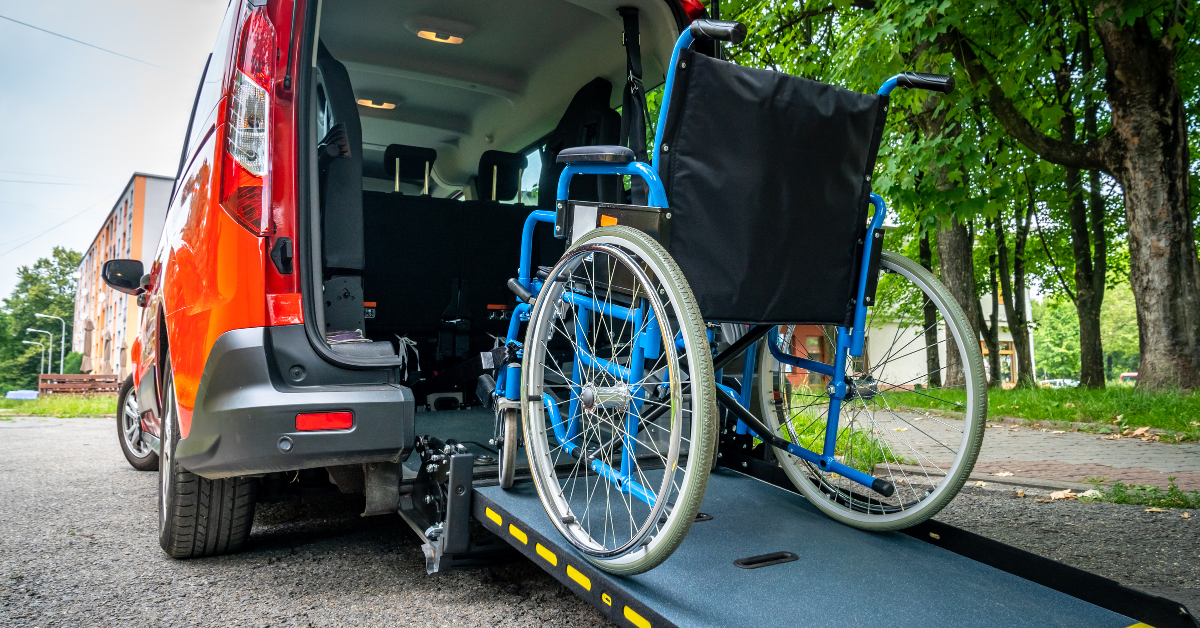
If a wheelchair was not secured in a medical transport van and you or a family member was hurt, you may have a claim even though the van never crashed. Georgia’s Medicaid transportation rules require drivers to confirm that every wheelchair and wheelchair passenger is properly secured before the van moves.
Here is what those rules require, how these injuries happen, who may be responsible and what to do next.
What Georgia and Federal Rules Require
Several layers of rules apply when a wheelchair user rides in a Georgia Medicaid transport van. They come from the Georgia Department of Community Health (DCH) NEMT Policy Manual, revised July 1, 2022, and federal Americans with Disabilities Act (ADA) regulations.
- Check before moving. Drivers must confirm that wheelchairs and wheelchair passengers are properly secured before the vehicle moves (DCH NEMT Policy Manual, Section 300.5).
- Securement equipment. Vehicles must comply with ADA rules, and wheelchair vans need a tie-down system at each wheelchair position (Manual, Sections 300.6 and 300.7). The federal ADA vehicle rules the manual adopts require a seat belt and shoulder harness for each securement position (49 CFR 38.23).
- Help from staff. Federal ADA rules call for providers to use their securement systems and for staff to help riders with securement systems, ramps and lifts when needed or requested (49 CFR 37.165).
- Lift assistance. Drivers must give passengers support and directions on the wheelchair lift (Manual, Section 300.5).
- Training. Drivers must complete driver training, including a passenger assistance program, plus first aid training (Manual, Section 300.13).
The manual treats securement failures seriously. A driver with one confirmed failure to properly secure a member’s wheelchair has to come off the road until completing securement training.
How Injuries Happen When a Wheelchair Is Not Secured
Common situations include:
- No one ties the wheelchair down, or the driver attaches only some of the tie-downs.
- The driver ties down the wheelchair but skips the passenger’s seat belt and shoulder harness.
- The driver brakes hard, speeds up quickly or takes a turn too fast.
- The passenger falls from a lift or ramp while boarding or leaving the van.
National data shows how often securement is part of the problem:
| Finding | National figure |
|---|---|
| Wheelchair users hurt or killed in motor-vehicle-related incidents each year | About 1,500 |
| Share of those hurt or killed where improper or no securement was involved | 35% |
| Share involving vans | 48% |
| Share involving lift malfunction | 19% |
Who May Be Responsible When a Wheelchair Is Not Secured
The transportation company and its driver
The transportation provider that operates the van, and its driver, are usually the main parties responsible. Georgia requires carriers of passengers to use extraordinary diligence to protect them (O.C.G.A. § 46-9-132). Georgia’s Court of Appeals has applied that standard to an ambulance, but no Georgia appellate decision we have found settles whether it applies to Medicaid transport vans, so the company may argue it owed only ordinary care. Either way, the DCH securement rules show what drivers are expected to do.
The Medicaid broker
In a 2025 case, a wheelchair passenger said a subcontracted driver failed to secure her wheelchair and then braked hard, throwing her to the floor. The Georgia Court of Appeals held that a jury should decide whether the broker, LogistiCare (now Modivcare), was responsible for its subcontractor. The court gave special weight to the broker’s mandatory wheelchair securement training and procedures (Georgia Insurers Insolvency Pool v. LogistiCare Solutions, Jan. 30, 2025). That ruling was not a final finding that the broker was liable. Learn more about when you can sue Verida or the transport company.
What to Do If a Wheelchair Was Not Secured
- Get medical care, and tell your doctor exactly how the injury happened, including any sudden stop or fall.
- Write down the date, pickup time, driver’s name, company name and van details while you remember them.
- Keep the wheelchair as it is. Damage to the chair or missing straps can be evidence.
- Report the incident to the DCH Member Contact Center at 1-866-211-0950, and ask the transportation company for its incident report.
- Have a lawyer send written requests to preserve in-van video and trip records before they are lost.
- Be careful with recorded statements and release forms from any insurer until you understand your claim.
Georgia Deadlines and Rules
Most Georgia injury lawsuits must be filed within two years (O.C.G.A. § 9-3-33). If a family member died, a wrongful death claim generally must be filed within two years of the death. If a city, county or other government agency operated the van, a written notice of claim may be due much sooner, in as little as six months. Under Georgia’s comparative fault law, you recover nothing if you are found 50 percent or more at fault (O.C.G.A. § 51-12-33). For the bigger picture, see our Georgia medical transportation accident guide.
Frequently Asked Questions
You may. A fall caused by an unsecured wheelchair, a hard stop or a lift accident can support a negligence claim against the transportation company, even with no collision.
Yes. Georgia’s Medicaid transportation rules require drivers to confirm that wheelchairs and wheelchair passengers are properly secured before the van moves, and DCH requires vehicles to meet federal ADA rules, which call for using the vehicle’s securement system.
Federal ADA transportation rules, which DCH requires vehicles to meet, say a provider may not deny transportation on the ground that a wheelchair cannot be secured satisfactorily by the vehicle’s securement system (49 CFR 37.165).
While your claim is pending, Medicaid generally pays for covered care after any other health coverage you have, such as Medicare, and is then repaid from the medical part of any recovery. Our post on who pays after a Medicaid van accident explains each source.
Generally two years from the injury, and two years from the death for a wrongful death claim. Do not wait, because evidence like in-van video can be lost.
Talk With Jonathan About a Wheelchair Securement Injury
Before founding Flack Injury Law, Jonathan Flack spent two and a half years on the insurance side of commercial truck and medical transport van cases, so he knows how these companies defend securement claims. If you or a family member was hurt, request a free consultation or call (678) 653-0309. You can also read how we handle Atlanta non-emergency medical transportation accident cases.
This article is general information about Georgia law, not legal advice for any specific situation. Laws change and outcomes depend on facts particular to each case. Reading this page or contacting Flack Injury Law through this website does not create an attorney-client relationship. Do not send confidential information until an attorney-client relationship has been established.