
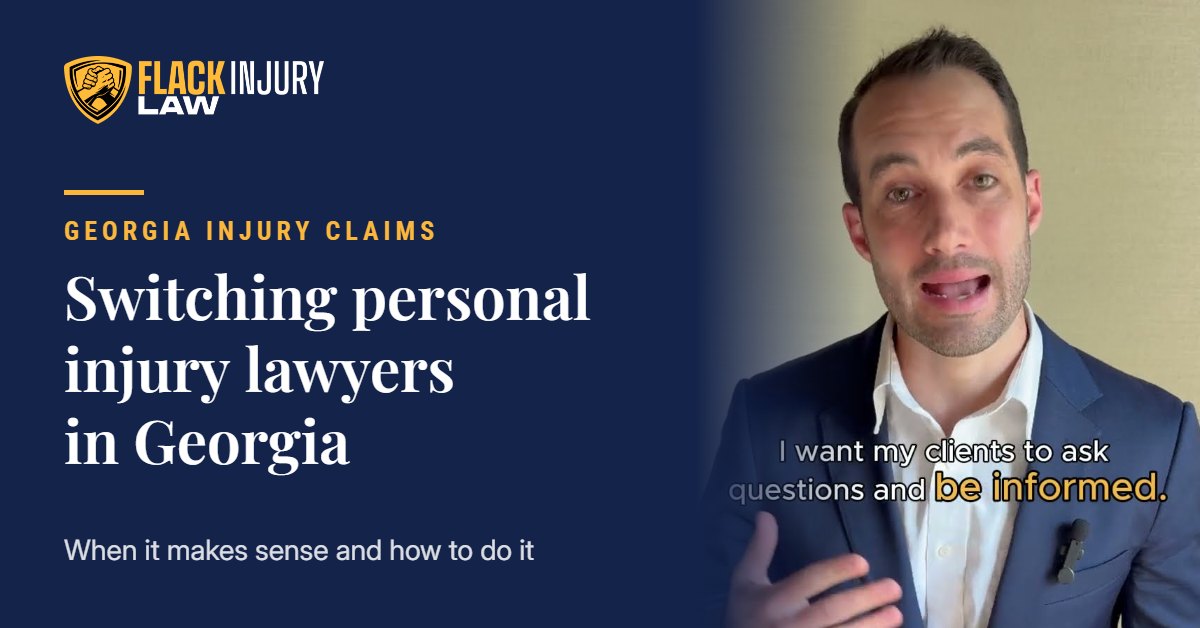
If your personal injury lawyer stopped returning your calls after a car, truck or rideshare crash, you are not stuck. In Georgia you can change lawyers in the middle of a case, and many people do. This guide explains when switching makes sense, what happens to the fee, and how to make the change without losing ground on your claim.
Video: Your attorney won’t call you back? (0:29)
Can you fire your personal injury lawyer in Georgia?
Yes. The official comment to Georgia Rule of Professional Conduct 1.16 says that “a client has a right to discharge a lawyer at any time, with or without cause, subject to liability for payment for the lawyer’s services.” Once you discharge your lawyer, the rule requires that lawyer to withdraw from your case. If a lawsuit is already on file, the court also has to allow the withdrawal.
You do not need to prove the lawyer did something wrong. Losing confidence in how your case is being handled is reason enough to talk to someone else.
Signs it may be time to switch
Georgia lawyers have a duty to communicate. Under Rule 1.4, a lawyer must keep the client reasonably informed about the status of the matter and promptly comply with reasonable requests for information. Warning signs include:
- Calls and emails go unanswered for days or weeks at a time.
- You have never spoken with the lawyer whose name is on your agreement, only with staff.
- You do not know what has been sent to the insurance company or what the next step is.
- You feel pressured to accept a settlement offer that no one has explained to you.
- Your two-year deadline is getting closer and no one has talked with you about a plan.
Will you have to pay two lawyers?
Most injury cases are handled on a contingency fee, so the fee comes out of the recovery. When a client ends a contingency agreement before the case is resolved, the Supreme Court of Georgia has held that the first lawyer cannot collect the contingency fee under the contract. That lawyer is limited to the reasonable value of the work already done, a concept called quantum meruit (Greer, Klosik & Daugherty v. Yetman, 269 Ga. 271 (1998)). Georgia law also gives attorneys a lien on the client’s recovery to secure fees owed (O.C.G.A. § 15-19-14).
In practice, that means your former lawyer’s claim is often resolved out of the recovery at the end of the case. Before you sign with a new lawyer, ask them to explain in writing how the prior lawyer’s claim will be handled and whether it changes what you take home.
Switching does not stop the clock
Changing lawyers does not pause the deadline to file a lawsuit. In most Georgia personal injury cases, that deadline is two years from the date of the crash (O.C.G.A. § 9-3-33). Claims involving a government vehicle can require written notice much sooner: within six months for a city (O.C.G.A. § 36-33-5) and within 12 months for the State of Georgia (O.C.G.A. § 50-21-26). If you are thinking about switching, do it early enough that your new lawyer has time to review the file and act.
How to switch personal injury lawyers
- Talk to the new lawyer first. Bring your agreement, any letters from the insurance company and your claim numbers. Flack Injury Law offers free consultations.
- Sign with the new lawyer. The new firm will usually send your former lawyer a written notice that you have changed representation and ask for your file.
- Get your file moved. When a representation ends, Rule 1.16(d) requires the former lawyer to take steps, to the extent reasonably practicable, to protect your interests, including surrendering papers and property you are entitled to.
- Send insurers to your new lawyer. Do not give a recorded statement or sign a release while the change is happening. Refer every adjuster to your new lawyer.
What you should expect from your injury lawyer
Video: What you deserve from your injury lawyer (0:36)
At Flack Injury Law, attorney Jonathan Flack handles every case personally and keeps a small caseload on purpose, so clients can reach the lawyer who is actually working on their case. If you were hurt in a car, truck, motorcycle, bicycle, pedestrian, rideshare or medical transport crash and your current lawyer is not communicating with you, call (678) 653-0309 for a free consultation. Jonathan can review where your case stands and explain your options before you decide anything.
This article is general information about Georgia law, not legal advice for any specific situation. Laws change and outcomes depend on facts particular to each case. Reading this page or contacting Flack Injury Law through this website does not create an attorney-client relationship. Do not send confidential information until an attorney-client relationship has been established.